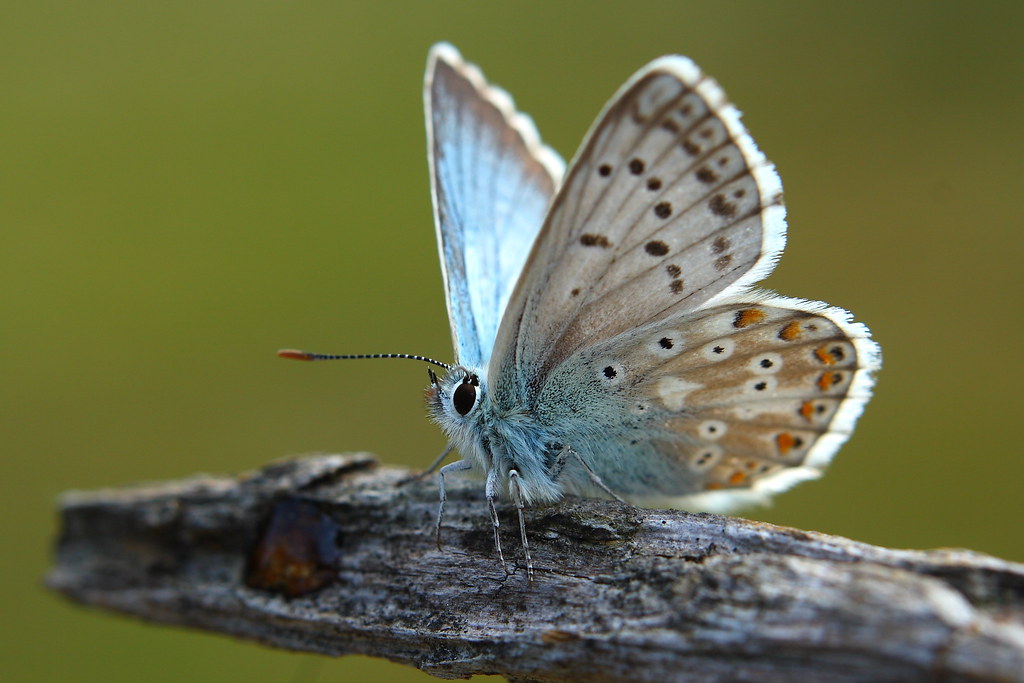
is estimated to be thousands of species belonging to this family. They are usually small, colorful, blue, red, green and blue. The eyes are often hairy, lacking maxillary palps, the sexual dimorphism, when present, is be borne by the color of the wings and lead to reduced front legs in males. In many species are present on the wings of one or more queues.
The egg is flattened and disc-shaped or dome. The larva is flattened, with retractable head, sometimes very hairy. The pupa looks attached to the caudal belt or free in the soil.
Plants nurses are countless and very difficult to restrict the list to a few plant families
Family Lycaenidae
The many species of animals belonging to the Italian Licenidi are characterized by small size. The most common colors are dark brown but also blue and red fire, in the case of the latter These are colors physical or data from pigments but from particular refraction of light, and that is why they can appear very bright. Frequent and sometimes significant, differences between males and females. The caterpillars have shortened the body and depressed, like small slugs, are provided processes everted, secreting substances appreciated and sought after by ants, which may engage in symbiosis with insects more or less close. As already mentioned, their diet may be partially or exclusively phytophagous insectivore (Mature larvae can feed on aphids, scale insects or ant larvae. The incrisalidamento, depending on the species, can occur on plants or in ant nests, pupae can be both free and fixed by silky threads.
Plebejus The Argus is a butterfly of 20-30 mm wingspan
wings in the male are blue-purple, edged with black, and females are brownish
The caterpillar has processes skin that secrete a sugary liquid to they eat ants, with whom they live; you incrisalida in anthills.
He completed two generations per year and adults flicker in May-June and August. It winters as egg
E 'common throughout Italy from the plains to the mountains, up to about 2000 m
The caterpillar is polyphagous but prefers legumes. On the map
nurse the larvae of many Licenidi interact, in varying degrees, with the ants in this peculiar phenomenon by the name of mirmecofilia.
mirmecofile The caterpillars of the species have special organs located generally on the skin of the abdomen segments: these glandular structures can produce volatile chemicals and, often, a sugary liquid like the honeydew secreted by aphids.
Why all this? The most supported hypothesis is that, early in their evolutionary history, the Licenidi have tried to defend itself from attacks by predatory ants: their caterpillars, are indeed having a thick cuticle and tough, and the shape of the body is squat and flattened, to protect the legs and head. Of course it would be better
completely avoid the attack the attackers disorienting: it is capable of in the sno Licenidi. In fact, they are able to emit volatile compounds that mimic the chemical language of ants, to prevent aggression and even raise their interest.
In addition, many species produce sugary substances in Licenidi ants are greedy and it is not uncommon to see these Hymenoptera while, on the backs of caterpillars, are intent on honeydew drops suck.
extreme case is represented by species of the genus Maculinea, whose larvae are adopted even by ants and carried into the nest, where they grow mature larvae devouring their hosts. And 'this is a real case of parasitism.
Curiosity
In Sardinia there are thirteen of the seventy species of Lycaenidae on the Italian territory. Three of them are endemic: the Pseudophilotes barbagiae, which is found only in some areas of which is surrounded 'island, corsica Lycaeides, which is also found in Corsica and in the' island 's Elba el' Aricia Cramer can be also found in Corsica .
The butterflies in this family are small and, for this reason are termed "microlepidotteri. Their colors tend to be gray, beige, blue and blue and sometimes metal.
They prefer mountainous habitat type is why you find it easily in the territories of Gennargentu Limbara and Monte Arci.


0 comments:
Post a Comment