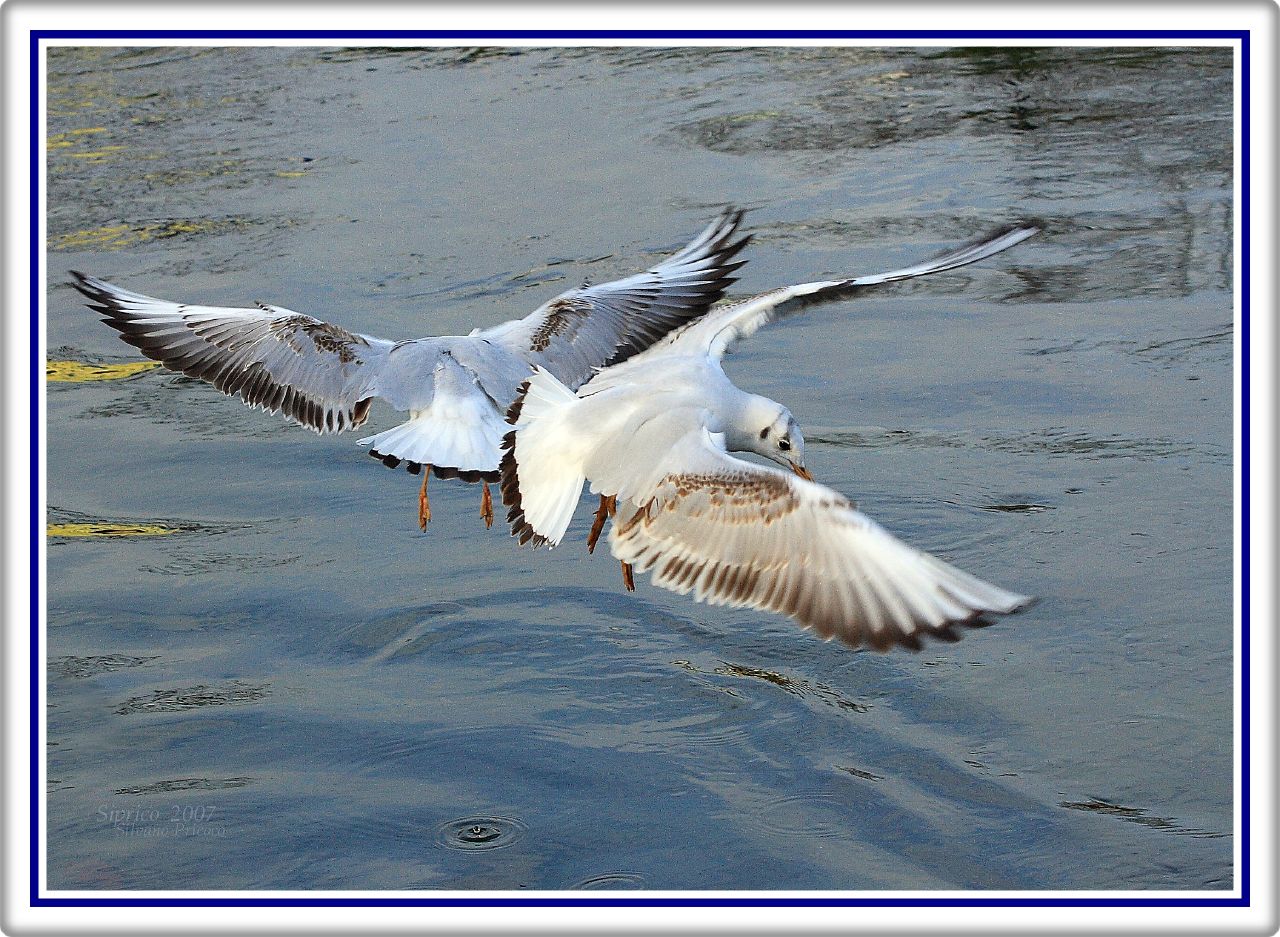
Common Name: GULL
Scientific name: Larus ridibundus
Family: Laridae (Laridae)
Order: Charadriiformes (Charadriiformes)
Class: Birds (Aves)
Birds of family Laridae and especially of the genus Larus. The black-headed gull (Larus ridibundus), common all over Europe, which is recognizable by the livery Bridal bluish-gray coat and cap color of coffee, nests in colonies. Other species are the herring gull (Larus argentatus), the Mediterranean Gull (Larus melanocephalus), the rosy gull (Larus genei).
The black-headed gull is 34-37 cm long, has a wingspan of 100-110 cm and weighs 280 to 320 g.
The plumage is mostly gray-white with black wing tips. In winter plumage tends to white. In summer the head is colored intensely black and the legs become reddish. The young sport a less plumage strongly colored with shades of brown, and during the first summer, the head becomes gray, anticipating the glossy black of the following year.
MIGRATION
headed gull populations in the north are migratory. The birds that live at lower latitudes tend to be rather sedentary. Most of the individuals residing in the northern Palearctic wetlands of central and northern Europe, but migrate to the Mediterranean basin during the winter. The birds that nest in Scandinavia migrate to Britain, although most most of them fly south until you reach the Atlantic coast of West Africa
Gabbiano in Italy is Reale
sedentary during the winter and moves more people can be added to the colonies of other peoples differences
Royal Gull / Gull
plumage
Herring Gulls: light gray upper parts, wings with black tips, white bottom. The young man has a background color stained and streaked with dark brown.
Gull: gray and white body, the front edge of the wings pure white. The young brown hues and gray throughout, with apex of the tail usually black.
Herring Gulls: light gray upper parts, wings with black tips, white bottom. The young man has a background color stained and streaked with dark brown.
Gull: gray and white body, the front edge of the wings pure white. The young brown hues and gray throughout, with apex of the tail usually black.
How to recognize
Herring Gulls: big yellow beak with red spot evident on the corner of the jaw, yellow legs in Mediterranean populations.
Gull: thin red beak and legs reddish speck in the winter dark circles around the eye.
Herring Gulls: big yellow beak with red spot evident on the corner of the jaw, yellow legs in Mediterranean populations.
Gull: thin red beak and legs reddish speck in the winter dark circles around the eye.
Herring Gulls Habitat: rocky shore, grass or bushes, or low sloping cliffs, lagoons, fields and buildings.
Gull: almost everywhere, even in inland cities.
Distribution
Herring Gulls: Widely distributed in Eurasia and North America, also with scattered colonies along the coast of north-west. Mostly sedentary and migratory.
Gull: Widely distributed in Eurasia. Migratory and dispersive.
Herring Gulls: Widely distributed in Eurasia and North America, also with scattered colonies along the coast of north-west. Mostly sedentary and migratory.
Gull: Widely distributed in Eurasia. Migratory and dispersive.
Herring Gulls Nest: Deep cup on the ground in grassy plateau dunes or on the coast of plant material.
Gull: nests in colonies, by massive cup of plant material.
Playing
Herring Gulls: colonial nests in isolated pairs. Usually lays 3 eggs a annually by the end of March. Incubation for 28-30 days to ensure that both parents. The small acts become the fly at 35-40 days of life.
Gull: colonial nests with related species. From April 3 lays eggs that hatch after 23-26 days of incubation, carried out by both parents. The young fly after 35 days. Is laid a brood year.
Herring Gulls: colonial nests in isolated pairs. Usually lays 3 eggs a annually by the end of March. Incubation for 28-30 days to ensure that both parents. The small acts become the fly at 35-40 days of life.
Gull: colonial nests with related species. From April 3 lays eggs that hatch after 23-26 days of incubation, carried out by both parents. The young fly after 35 days. Is laid a brood year.
Power
Herring Gulls: collects any type of food, it is often found in landfills or on fishing vessels and ferries. Preda also frequently small and eggs of other species as well as other animals dead or alive.
Gull: practically the same eating habits of the herring gull.
Herring Gulls: collects any type of food, it is often found in landfills or on fishing vessels and ferries. Preda also frequently small and eggs of other species as well as other animals dead or alive.
Gull: practically the same eating habits of the herring gull.
Sounds
Herring Gulls' kliu "," kiau-kiu.
Gull: a hoarse "aaarrgghh.
addition to the herring gull, the most common European species are the mugnaiaccio (Larus marinus), large (68 cm in length), widespread on the coasts of North America and Europe but rare in Italy, the saffron (Larus fuscus), smaller than the mugnaiaccio (53 cm), with yellow legs and also adapted to the environment of the hinterland; the black-headed gull (Larus ridibundus), about 38 cm long, gregarious and widely coastal and inland, very common in Italy; the Gabbianello (Larus minutus), the smallest European species (28 cm), easily recognizable by the black hood that covers almost the entire neck; Larus audouinii, breeding in the Mediterranean, particularly in Sardinia
zampegialle The herring gull (or Mediterranean gull) (Larus michahellis, Naumann 1840) is a bird belonging to the family of Charadriiformes Laridae. It can be confused with the Herring Gull (Larus argentatus) with which coexists in some nursery areas and the Caspian gull (Larus cachinnans). The yellow-legged gull, however, is characterized by a clear and livery is lighter than the Herring Gull .
Curiosity
Although environmentalists argue that any kind of bird is harmful, there are some species that are considered in many of the scourges of the world. For others the speech is diametrically opposite: the United States, in Salt Lake City, was erected a statue in tribute to a bird, that quietly performs its mission more organic "to destroy the grasshopper, the most dangerous insect 's agriculture. This is the voracious gulls, and the monument was erected in memory of the seagulls in the last century wiped out a huge swarm of locusts
Herring Gulls' kliu "," kiau-kiu.
Gull: a hoarse "aaarrgghh.
addition to the herring gull, the most common European species are the mugnaiaccio (Larus marinus), large (68 cm in length), widespread on the coasts of North America and Europe but rare in Italy, the saffron (Larus fuscus), smaller than the mugnaiaccio (53 cm), with yellow legs and also adapted to the environment of the hinterland; the black-headed gull (Larus ridibundus), about 38 cm long, gregarious and widely coastal and inland, very common in Italy; the Gabbianello (Larus minutus), the smallest European species (28 cm), easily recognizable by the black hood that covers almost the entire neck; Larus audouinii, breeding in the Mediterranean, particularly in Sardinia
zampegialle The herring gull (or Mediterranean gull) (Larus michahellis, Naumann 1840) is a bird belonging to the family of Charadriiformes Laridae. It can be confused with the Herring Gull (Larus argentatus) with which coexists in some nursery areas and the Caspian gull (Larus cachinnans). The yellow-legged gull, however, is characterized by a clear and livery is lighter than the Herring Gull .
Curiosity
Although environmentalists argue that any kind of bird is harmful, there are some species that are considered in many of the scourges of the world. For others the speech is diametrically opposite: the United States, in Salt Lake City, was erected a statue in tribute to a bird, that quietly performs its mission more organic "to destroy the grasshopper, the most dangerous insect 's agriculture. This is the voracious gulls, and the monument was erected in memory of the seagulls in the last century wiped out a huge swarm of locusts


0 comments:
Post a Comment